CHI 2026
Design System-Compliant User Interface Generation with LLM Agents: A Comparative Study of Context Engineering Strategies
SeungEon Cha, Sunghyun Jo, Jongho Shin, Kyoungwon Seo
Abstract
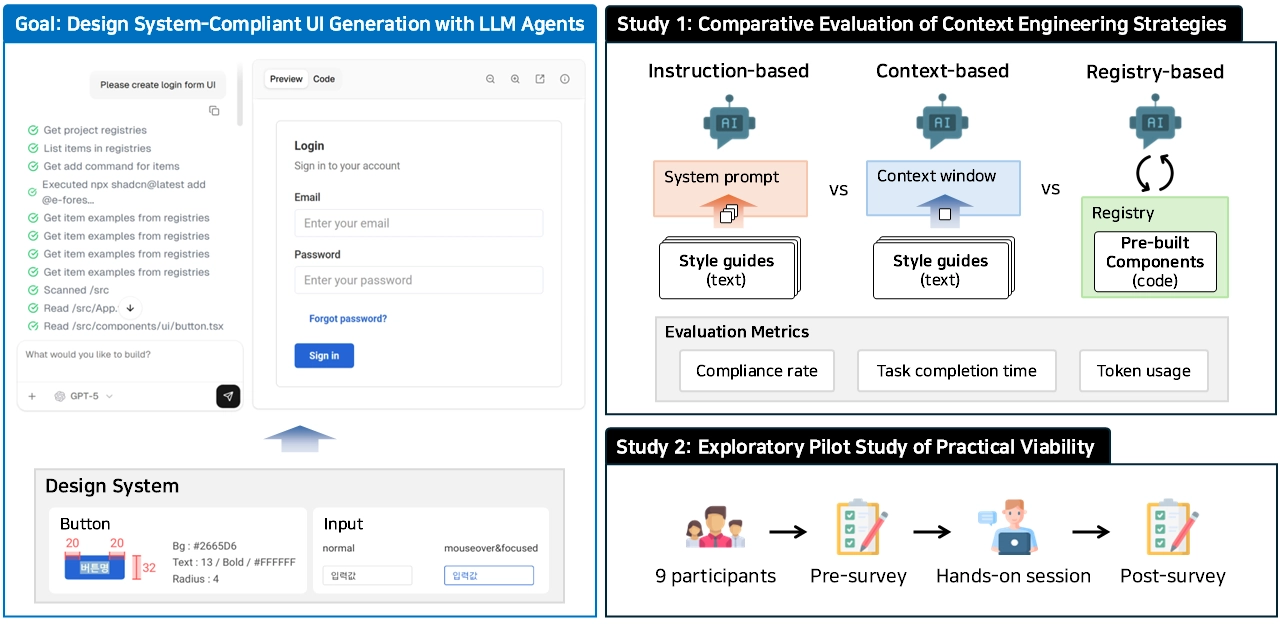
Large language model (LLM) agents are increasingly used for user interface (UI) generation, yet they often fail to apply organization-specific design systems. It remains unclear which context engineering strategy enables dependable compliance. This study compares three context engineering strategies for integrating design systems into LLM agents: instruction-based (embedding complete style guides in prompts), context-based (injecting task-relevant style guides into the context window), and registry-based (assembling pre-built components in the registry). We evaluate each strategy on compliance rate, task completion time, and token usage by generating six real-world UIs. Results show that the registry-based strategy achieved the highest compliance rate (95.08%), outperforming others with only moderate overhead. Our pilot study with nine practitioners further indicates reduced perceived difficulty and time burden while enhancing self-efficacy in their workflows. These findings demonstrate that using pre-built components in the registry enables more reliable and scalable design system-compliant UI generation with LLM agents.
Related Projects
- Agentic AI 기반 UI/UX 생성-평가-개선 프로세스 자동화 기술 개발
2026.09 — 2027.06